
Taking Up Space in Midlife: Why You Stopped, and How to Begin Again
Aug 25, 2026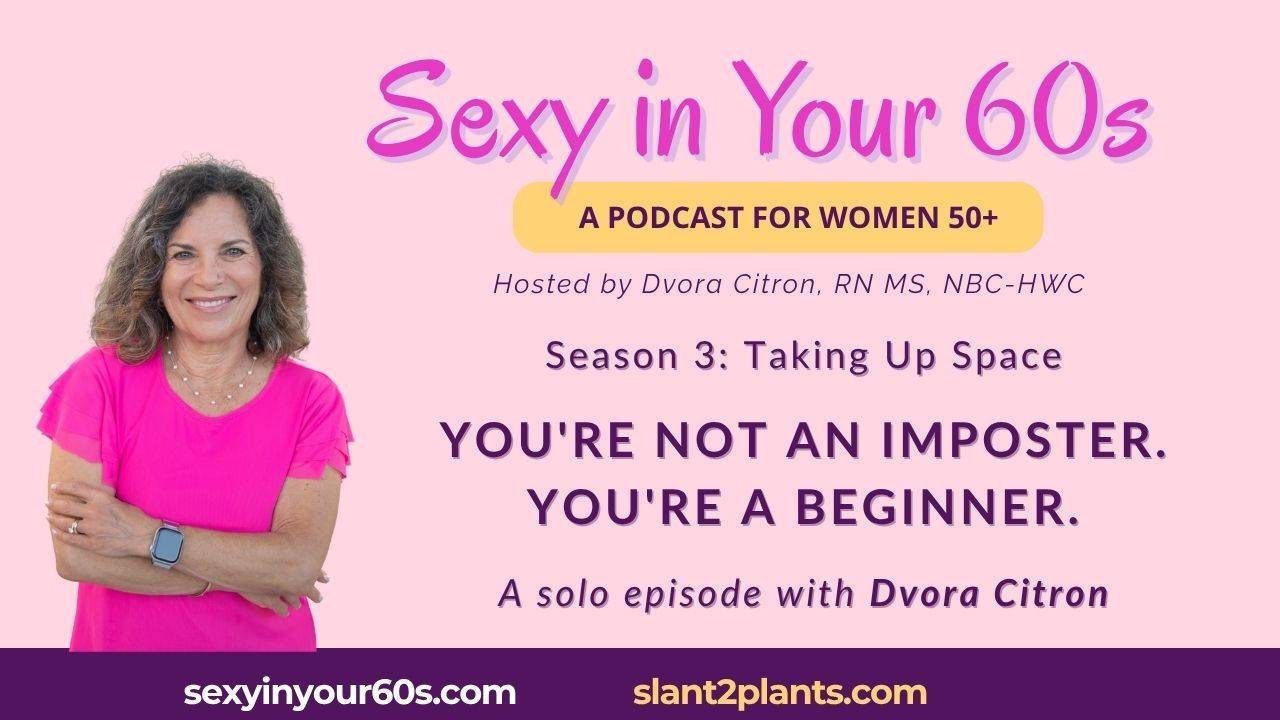
I grew up in a dress shop.
My father owned a petite women's clothing store in Los Angeles, and I did not just spend time there. I worked it, from the time I was ten and making macramé belts to sell in the store, all the way through my early twenties when I was still in nursing school. I learned the day-to-day operations of running R/S Petites. But my father taught me something much more important than that. He taught me to treat every person who walked in with dignity and respect, no matter how they appeared, and never to make assumptions about who they were or what they could afford.
That store is also where I first understood something about midlife confidence that took me another forty years to put into words. There were two kinds of women in that dressing room. Some came out. They pushed the curtain back, stood in front of the three-way mirror, turned, looked, and said something out loud about what they saw. And some stayed behind the curtain. I used to check on those women. I would peek in and ask if they needed a different size or another color, and whether they wanted me to tell them how it looked. Some let me. Most handed the garment back over the door and said they were fine.
What Taking Up Space Actually Means for Women Over 50
Season 3 of Sexy in Your 60s is called Taking Up Space, and I want to be precise about what I mean, because the phrase gets used badly.
What I do not mean:
- Being louder
- Demanding more, or interrupting more
- Elbowing your way to the front of something
- Taking up space at someone else's expense
What I mean is closer to what happened in that dressing room. Taking up space is having enough room in your life, mentally, emotionally, and physically, to try something on. To consider a version of yourself you have not been yet. To pay attention to how it makes you feel rather than how it looks to everybody else. And to do all of that without having to know in advance whether it is going to work out.
Trying something on is not committing to it. That is the whole point of a dressing room.
Or to say it another way: taking up space is showing up without qualifying for it.
Where Midlife Guilt Actually Comes From
There is a guilt that shows up in women our age, and I do not think it is what people say it is. It is not laziness. It is not selfishness. It is not a personal failure of discipline.
If you built a life around being available, and most of us did, then time for yourself has to come out of somebody else's column. That is not a feeling. It is a rule you were taught before you were old enough to question it. Every hour you spend on something that is only yours is an hour subtracted from someone who is used to having it. And you can feel that subtraction, even when nobody complains.
So we get very good at wanting small things. Things that do not cost anyone anything. I have written before about the years I spent crumpling on the floor after every holiday, which is what happens when the subtraction goes on long enough.
Why Confidence Fades When Your Roles Expire
There is a second piece, and this one is structural.
Think about the roles you have held. Mother. Nurse, teacher, manager, physician, business owner. Parents' club president. The one who organized the holidays. The one who handled your parents' medical appointments. Those were not just jobs. They were a feedback system. They came with a room full of people who told you, constantly and in a hundred small ways, that you were doing it right.
And then those roles expire. Or they transition, or they get handed off, or the people who needed you stop needing you in the same way. If you are in the middle of that shift right now, Empty Nest, Full Life goes deeper into what that transition actually asks of us.
Here is the part nobody explains. Your competence did not go anywhere. What went away was the confirmation.
In the absence of anyone telling you that you are doing this well, most of us read the silence as information about ourselves. That is the mistake. The silence is not a verdict. It is an empty room where a system used to be. I wrote about the quieter version of this in The Silent Confidence Killers in Your 50s and 60s.
You Are Not an Imposter. You Are a Beginner.
When a woman in her sixties tries something new and feels shaky about it, somebody will hand her the phrase imposter syndrome. I do not think that is what this is. Imposter syndrome is feeling like a fraud when the evidence says you are not.
But if you are genuinely new at something, you are not imagining the gap. You are a beginner. You actually do not know how to do the thing yet.
The problem is not that you are delusional about your competence. The problem is that our culture gave women almost no permission to be beginners after about the age of thirty. So being new feels shameful instead of simply being early.
Beginner is a stage. A syndrome is a condition. One of those, you move through.
I have lived this one from the inside. The Price of Starting Over is what it actually cost me to begin again after a forty-year career. And if you are weighing a real reinvention, Going Back to School After 50 is an honest look at what that requires.
Why Midlife Confidence Is a Health Question, Not a Self-Help One
I want to be clear that this is a health conversation and not a pep talk.
There is a well-known meta-analysis by Julianne Holt-Lunstad and colleagues that pooled 148 studies and more than 300,000 people. They found that people with stronger social relationships had a 50 percent greater likelihood of survival, and they concluded that the influence of social relationships on how long we live is comparable to well-established risk factors like smoking, and greater than physical inactivity or obesity.
There is a separate line of research on purpose out of Rush University that found a higher sense of purpose in life associated with a substantially reduced risk of death from any cause. That work was done in adults considerably older than most women reading this, and both of these are observational studies, so they show association rather than proof. But the direction is consistent and it has held up.
I went further into this evidence in Community Is Longevity Medicine, which looks at what the Blue Zones research and the third-places literature actually say about belonging.
Here is what it means for you. Staying engaged with your own life is not a luxury item. A woman who stops trying things on stops being met by the world, and the research suggests that has consequences in the body, not just the mood.
What Taking Up Space Cost Me, and What It Gave Back
I have had two back surgeries and both hips replaced. During those stretches I was not the nurse, I was not the one running the household, and I was not the person other people leaned on. I was the one being helped. That is disorienting when your entire identity has been built on being the capable one.
The surgeries went well. But there was no going back to the previous version of my body. I had to work out who I was going to be with the body I actually had. I documented that rebuild in real time, including where I stood eight weeks out, what recovery looked like four months later, and where I landed a full year on.
I gave up running. I gave up tennis. Those were real losses and I am not going to dress them up as blessings.
And here is something else. Everyone I know is playing pickleball, and I am not. Maybe I could. It is a whole thing, and I do not have the drive for it right now. What I would actually like to learn is golf, so I can spend time with my mother while she is still out there playing. That is also taking up space. Choosing what you actually want instead of the thing everybody says you should want is exactly the muscle I am talking about.
Here is what I do instead:
- Walking, which matters more the older we get
- Hiking
- Yoga and Pilates
- Strength training
- Stand up paddleboarding, which nobody would have predicted given my hips and my back history
You do not get to keep everything. The losses are real. But what is still available to you is almost always wider than the list you would write from fear. That is really what Refusing to Fade is about.
My Mother on the Greens
My mother took up golf in her sixties. She is in her mid-eighties now and she still plays most days. My father died four years ago, so she goes out without him, without a foursome, and often without a plan. She drives out in her cart in her purple outfit and she plays as much of the course as she feels like playing.
She does not finish. She does not care. She is not out there proving she can still play nine holes. She is out there because it is hers.
If you want more of her, I wrote about what she has taught me in You Can Never Be Lonely with Purple Hair, and I have written about what actually happens to your social life when you move to a 55-plus community.
One Honest Caveat About Aging Well
I am not telling you that every woman needs to do this. I am not telling you that you are doing this chapter wrong if you are content exactly as you are. This is yours to decide, and anybody who tells you there is a required version of aging well is selling you something.
What I am telling you is that if some part of you has been waiting for permission, consider this me handing it to you.
Go stand in front of the mirror. Push the curtain back.
Listen to the Full Episode
Episode 40: Taking Up Space, Season 3 Premiere
Podcast Page
Apple Podcasts
Spotify
Amazon Music
Watch on YouTube
Research Referenced in This Episode
Holt-Lunstad J, Smith TB, Layton JB. Social Relationships and Mortality Risk: A Meta-analytic Review. PLoS Medicine, 2010;7(7):e1000316.
Boyle PA, Barnes LL, Buchman AS, Bennett DA. Purpose in Life Is Associated With Mortality Among Community-Dwelling Older Persons. Psychosomatic Medicine, 2009;71(5):574-579.
About Dvora Citron
Dvora Citron is a Registered Nurse, National Board Certified Health & Wellness Coach, Lifestyle Medicine Practitioner, and the founder of slant2plants®. She hosts Sexy in Your 60s to bring women the real ingredients of vibrant aging through science, story, support, and soul. Her work helps women 50 and older create the health, confidence, and longevity they want in ways that feel realistic and sustainable.
slant2plants.com
Blog
Instagram @slant2plants
LinkedIn
Pinterest
Start Where You Actually Are
You cannot try anything on until you know where you are standing right now. That is what The 5-Minute Reality Check for Women 50+ is. It is a live workshop I run once a month, about an hour, and it walks you through a five-minute self-assessment and then what to do with what it tells you. You leave knowing where you actually are, without anyone asking you to fix a thing.
Find the next date and sign up at slant2plants.com/realitycheck
Want to know when the next Sexy in Your 60s Coaching Experience opens? Join the waitlist
Which One Are You Avoiding?
Strength, fiber, sleep, alcohol. These are the four foundations that matter most after 50, and most women are solid on three.
The 5-Minute Reality Check is a free live workshop. You'll get an honest score across all four, find your blind spot, and leave with a seven-day move you can actually follow, plus a minimum version for the weeks that fall apart.
Live on Zoom. No replay.
Author

About Dvora Citron
I'm a Registered Nurse with 40+ years of experience, a National Board Certified Health and Wellness Coach, and the founder of slant2plants®, a plant-forward approach to vibrant living, healthy aging, and feeling fully alive in your 60s and beyond.
I write, teach, and coach women over 50 who are ready to nourish their bodies, reclaim their energy, and step into the most confident chapter of their lives.
🎙️ Listen to the Sexy in Your 60s™ podcast: interviews with women and experts on healthy aging, longevity, and what it truly means to feel grounded, confident, and at home in your life after 50.
📅 Ready to go deeper? Book a free Health Coaching Discovery Call
