
I Used to Crumple on the Floor After Every Holiday
Apr 04, 2026
Why wait until your 60s to stop crumpling on the floor?
I want to tell you about two Passovers.
The first one happened many times, across many years. Different years, different guests, different menus — but always the same ending.
The seder was beautiful. The table was set perfectly. The food was abundant. Everyone left full and happy, talking about what a wonderful evening it had been. And then the door closed behind the last guest, and I crumpled onto the floor.
Not dramatically. Not visibly. Just — down. Completely depleted. Nothing left. The woman who had held everything together all week, all day, all evening, finally letting go because there was no one left to perform for.
I did that for years. And I called it being a good host. A good mother. A good wife. A good daughter. A good sister.
What I was actually doing was pouring every last drop of myself into everyone else and leaving nothing — not a drop — for me.
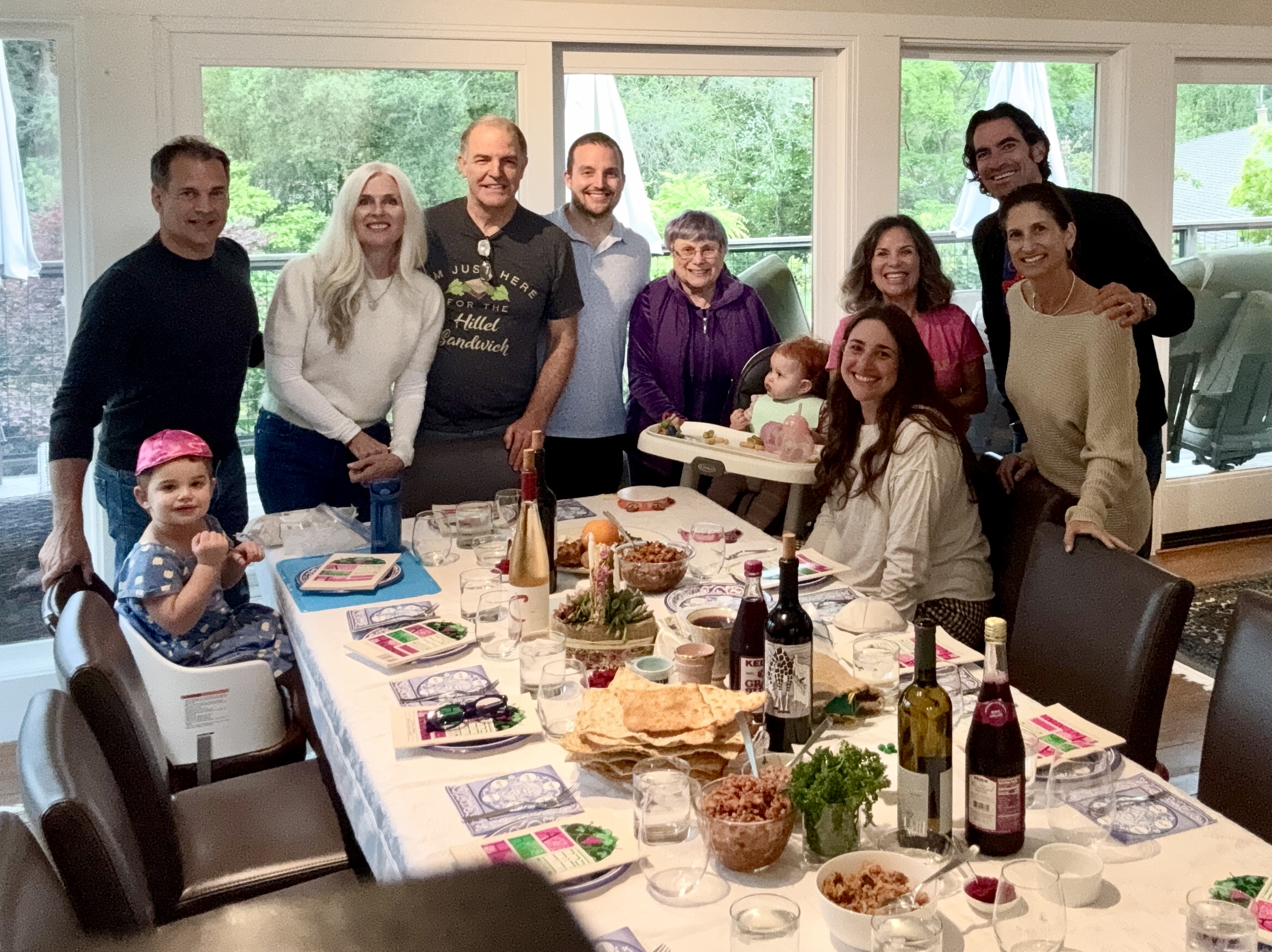
Passover 2026. Nine adults, two little ones, and a table that held everything.
Why This Year Was Different
This Passover, my oldest son's family came to stay for four days — including a one-year-old and a three-year-old, which is its own particular brand of beautiful chaos. We also had my mother, my sister and her husband, and my brother and his wife join us for the seder. Nine adults and two young children around the table.
In previous years, that would have been a setup for the crumple.
This year, I did something different. Several things, actually. Small things that turned out to matter enormously.
The morning my son's family arrived, I did my weight workout. I knew that once they were there, the room with our exercise equipment would be occupied — and honestly, I wouldn't have wanted to spend my time that way anyway. So I protected that window before it closed. Every day of their visit, I got my walk in. I made sure we had plenty of healthy food available, and I ate it. I didn't save my own nourishment for after everyone else was taken care of.
I paced myself across the whole week, not just the day of the seder. Energy is cumulative. You cannot run on empty all week and then expect to show up full for the main event.
I asked for help in advance — specifically, directly, early enough that I wasn't white-knuckling it through the day hoping someone would offer. I messaged my brother and sister ahead of time, thanked them, and told them exactly what I wanted them to bring and what help I would need during the seder. It wasn't much. But knowing it was handled meant I wasn't carrying the weight of hoping and being disappointed.
I let go of my expectation that everything had to be perfect. I made a conscious decision before the week began that I was going to go with the flow — especially with young children in the house. That the seder would be what it was, not what I'd always imagined it should be.
After the kids went to bed, the seder wound down and my 85 year old mom headed home, the four couples sat together and just visited. For a long time. And I was still there. Present. Not performed out. Actually there.
My mother noticed I wasn't exhausted. My sister looked at me at some point during the evening and said: "You seem lighter."
Lighter. That word stopped me.
Because she was right. And because I realized I had never felt lighter after a Passover before. I had felt relieved. I had felt proud. I had felt exhausted in that particular way that masquerades as satisfaction. But lighter? Never.
On Partnership — and the Labor That Doesn't Get Seen
I want to say something clearly, because I think it matters.
My husband and I have always been equal partners in how we run our home and how we host. He is not someone I delegate to. He is not someone who assists me. We work together — that has been true for our entire marriage, and it is part of the foundation everything else is built on. I don't take it for granted for a single moment.
But here is what has always been almost entirely mine alone, even in an equal partnership: the emotional labor.
The worrying in advance. The anticipating everyone's needs before they know they have them. The managing the undercurrents at the table. The carrying of the meaning of the whole thing: the food dishes, the table setting, the music and songs, encouraging participation while meeting everyone's needs, the awareness of who is missing, the hope that the heritage is landing, the integration and synergy that runs underneath everything else. That has always lived inside me, privately, handled alone..
What I am getting better at — finally, in my 60s — is not doing that part alone anymore.
I talk it through with my husband first now. Before the week begins, before the guests arrive, before I've already started carrying it. I let him into my internal experience. I tell him what I'm worried about, what I'm hoping for, what I need. Not after the fact. Not when I'm already depleted. Before.
That's the part that changed this year. Not the logistics. The intimacy. Letting my partner be a partner in my experience, not just in the work.
If you are in a partnership where the physical labor is genuinely shared but the emotional labor is still entirely yours — that imbalance is real, and it costs you something every single time. You don't have to keep paying it alone.
This Is for Everyone at the Table
My audience is mostly women. And yes, I am speaking directly to you.
But I want to be honest about something: the modeling we do in our marriages and our families isn't only for our daughters. It's for our sons too. And for our sons-in-law. And for our daughters-in-law.
We have two adult sons and a daughter, all married. And I think about all six of them — not just the women — when I think about what we've passed down and what we still can.
Our sons have watched their father their whole lives. They've watched a man who shows up as a full partner — not a helper, not someone who assists when asked, but someone who co-creates the home and the gathering and the life alongside his wife. That is what they know a husband looks like. That is the template they carry into their own marriages.
Our daughter has watched me. She has watched what it looks like when a woman carries the emotional labor alone and how that burden is expressed. She has also watched, this year, what it looks like when she starts to put it down.
And our daughters-in-law — who came into this family with their own histories, their own templates, their own ideas about what a marriage and a home and a gathering should look like — they are watching too.
What we model in our own marriages is the most powerful parenting we will ever do. Not what we say. What we live.
So when I talk about learning to share the emotional labor, I'm not just talking to the women. I'm talking to the men too.
To my sons and son-in-law: your wife is carrying more than you can see. Not because she is weak — because she is capable, and capable people absorb what others don't notice. Ask her what she's carrying. Before the holiday. Before the guests arrive. Before she's already underwater. Ask her, and mean it, and let her answer change something.
To my daughter and daughters-in-law: you are allowed to put it down. The emotional labor, the need for perfection, the performance of having it all together. You are allowed to talk to your partner before you're depleted. You are allowed to ask for what you need specifically and early. You are allowed to still be standing when the door closes.
That is not weakness. That is what a sustainable life looks like.
The Unintended Consequence of Doing It Too Well
Here is something I've been sitting with, and I want to say it honestly even though it's complicated.
My husband and I have hosted extraordinary gatherings our whole lives. The seders especially. Over the years I've accumulated supplies, Judaica, haggadahs, toys and books for the children, decorations, ritual objects — all the physical richness that makes a Passover seder come alive. I'm good at storing things. I have the space. And I have a deep emotional and intellectual investment in passing on the beauty and meaning of our heritage.
Our children grew up watching us host. They saw how much care went into it. How much invisible labor. How much of ourselves we poured into every gathering.
And here's the complicated truth: Gen Z has language for all of it that we never had. They talk about emotional labor, boundaries, burnout. They can name what we could only feel.
But naming something and escaping its pull are two different things. Some of them are consciously doing it differently. And some of them are quietly doing the same thing we did, just in their own way, without recognizing it yet.
What I want them to see from us now isn't the perfect gathering. It's the real one. The one where we asked for help, let things be good enough, and stayed standing at the end.
That's worth more than any template.
When we make something look too easy, we can accidentally make it look impossible to replicate.
What I want my children — all of them, and their partners — to see now is not the perfect seder. It's the real one. The one where I asked for help, paced myself, let things be good enough, and stayed standing at the end. The one where I was lighter.
That's an inheritance worth passing down. Not the Judaica collection. The practice underneath it.
Why Wait Until Your 60s?
Here is the truth: most of us don't learn this until we're forced to. Until the body says no. Until the burnout becomes impossible to ignore. Until we've spent so many years crumpling on the floor in private that we finally get curious about whether there's another way.
I am in my 60s. And I am just now, just now, experimenting with this.
Which means I spent decades hosting the most beautiful gatherings, raising children, building a marriage, working and going to grad school, showing up for everyone around me, doing it with tremendous love and tremendous competence — and doing it in a way that quietly cost me.
You don't have to wait as long as I did.
The crumple on the floor is not the price of being a good woman. It is evidence that something needs to change.
And the change doesn't have to be dramatic. It can be a morning workout before the family arrives. A specific ask sent to your siblings in advance. A conversation with your partner about what you're carrying before you're already carrying it alone. A talk with your adult children about what you need to do to take care of yourself when you're the host. A decision, made quietly before the week begins, that good enough is enough.
My sister said I seemed lighter.
I want that for you. Not someday. This year. At your own table.
What's one thing you could do differently at your next gathering — one thing that would help you stay standing at the end? I'd love to hear--reply and let me know.
🩷Dvora
Which One Are You Avoiding?
Strength, fiber, sleep, alcohol. These are the four foundations that matter most after 50, and most women are solid on three.
The 5-Minute Reality Check is a free live workshop. You'll get an honest score across all four, find your blind spot, and leave with a seven-day move you can actually follow, plus a minimum version for the weeks that fall apart.
Live on Zoom. No replay.
Author

About Dvora Citron
I'm a Registered Nurse with 40+ years of experience, a National Board Certified Health and Wellness Coach, and the founder of slant2plants®, a plant-forward approach to vibrant living, healthy aging, and feeling fully alive in your 60s and beyond.
I write, teach, and coach women over 50 who are ready to nourish their bodies, reclaim their energy, and step into the most confident chapter of their lives.
🎙️ Listen to the Sexy in Your 60s™ podcast: interviews with women and experts on healthy aging, longevity, and what it truly means to feel grounded, confident, and at home in your life after 50.
📅 Ready to go deeper? Book a free Health Coaching Discovery Call
